

1 October 2026
Navigating uncertainty together
In Part 1 of our Middle East Special, Henk-Jan Bouwman shared how Cefetra Dairy responded when geopolitical tensions disrupted supply chains across the region. In Part 2, we look at the same period from a customer’s perspective. Gaurav Mahajan, Procurement Lead at Hadaf Foods in Abu Dhabi, explains how the disruption affected the company’s production, logistics and working capital, and why close cooperation with suppliers became more important than ever.
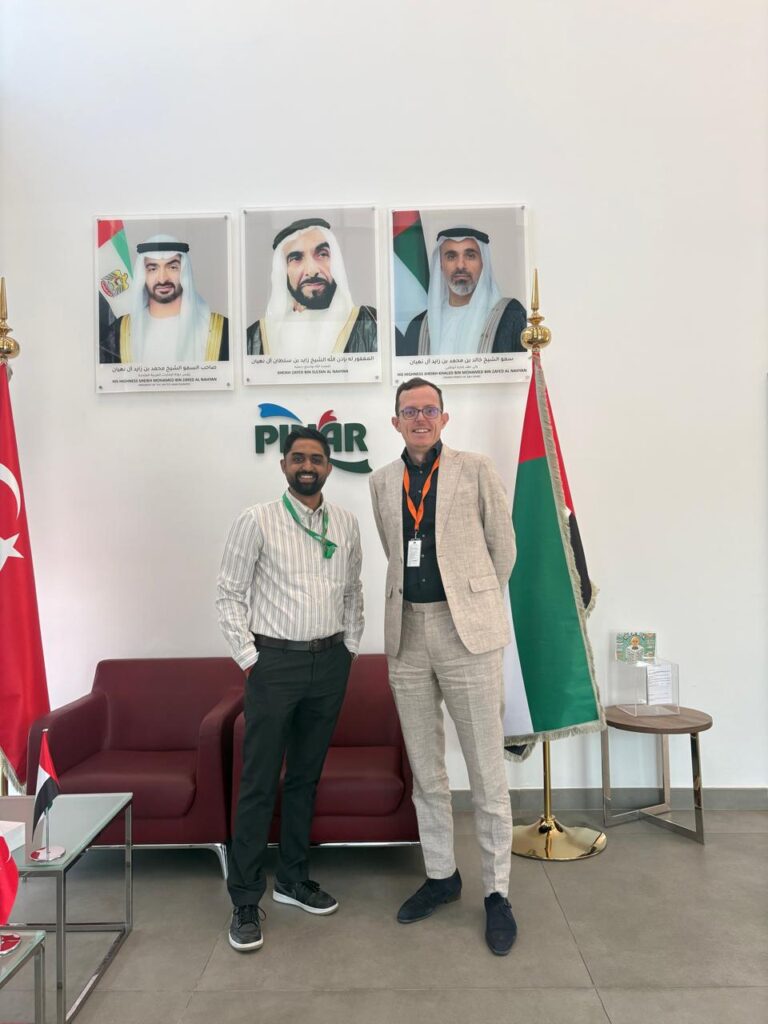
“Our business relationship has become stronger, because we are now working more closely as partners rather than simply as a supplier and customer.”
Gaurav Mahajan, Procurement Lead at Hadaf Foods
Gaurav, how long has Hadaf Foods been working with Cefetra Dairy, and how would you describe the relationship before the recent disruption?
We have been working with Cefetra Dairy for almost three years. Since I joined Hadaf Foods one and a half years ago, I have worked closely with Henk-Jan as our main point of contact.
We source products such as skimmed milk powder from Europe and are exploring further opportunities together. Over time, the relationship has developed beyond individual transactions, reflecting the growing trust between our companies.
We have plans to increase our business with Cefetra Dairy. Particularly during the past year, we have experienced the reliability and level of service that Cefetra Dairy provides, and we are very happy with the relationship.
When the situation in the region changed, what did that mean for Hadaf Foods?
When the conflict started, we did not know what was going to happen. Like many others, we initially expected it to be a short-term issue that might be resolved within two or three months. When that did not happen, we had to keep adapting.
As a manufacturer, we cannot simply stop production. We need raw materials and packaging materials to arrive so that we can continue operating and serve our customers. We therefore remained in constant contact with suppliers and shipping lines to understand which routes and ports were still available.
Before the conflict, most suppliers delivered to Abu Dhabi under CIF or CFR terms, which meant that we mainly handled clearance at the port. When suppliers began struggling to secure vessels and bookings, we had to take on a much larger part of the supply chain ourselves. We started arranging some shipments on an FOB basis, including vessel bookings, documentation, transport and insurance. That was a major operational change for our business.
Looking beyond the immediate shipping issues, what were the wider consequences for your operations?
The uncertainty affected much more than the movement of containers. We faced challenges with raw materials and packaging materials, but we also had to consider whether we would be able to keep the factory operating.
Our site is located in KEZAD, close to Abu Dhabi, in an area that was heavily affected by the situation. Maintaining business continuity and keeping the factory operating during this period was therefore a key priority for us.
Cash-flow and working-capital management also became more challenging during this period. Suppliers were trying to support us, but they were facing their own limitations.
At the same time, material prices increased because of higher fuel and crude-oil costs. As a relatively new manufacturing operation, we are not a cash-rich company. Managing working capital while keeping production running therefore became one of our biggest challenges.
During a period of major uncertainty, what do you need most from a supplier?
We need suppliers to understand our situation and work with us as a team to find solutions.
One example was a shipment that was due to leave just as the conflict started. Henk-Jan and I looked at the available options together. Cefetra Dairy worked with its logistics team, while we involved our clearing agent and logistics team.
Together, we arranged a trial shipment through an alternative route that was less affected by the disruption. This allowed the supply to continue.
It was the first time we had developed this particular route with a supplier. The trial provided an alternative that we may also be able to rely on in future if the situation deteriorates again. It was a genuine team effort, with flexibility and involvement from both sides.
Did the situation change the way Hadaf Foods and Cefetra Dairy work together?
Logistically, we adapted together to keep the supply moving. More broadly, I would say that our business relationship has become stronger. We are now working more closely as partners rather than simply as a supplier and customer completing individual transactions.
As a manufacturer, we need suppliers we can rely on. At Hadaf Foods and Pınar, we believe in developing long-term relationships. Some Pınar suppliers have worked with the company for 40 years. We do not believe in changing suppliers frequently; we try to create a win-win situation and regard our suppliers as partners.
Cefetra Dairy has demonstrated that approach during this challenging period. We have been in close contact, sometimes speaking every day to assess the situation and determine what we could do.
What I particularly appreciate is that Cefetra Dairy does not look only at securing the next order. Henk-Jan also considers what makes commercial sense for Hadaf Foods. For example, he has proactively advised us on purchasing decisions and market timing, helping us manage costs and uncertainty more effectively.
That kind of advice gives us the reliability we need as a manufacturer and reinforces our confidence in Cefetra Dairy as a long-term partner.